Saturday, 6 April 2024

Go and take your Weekly Assessment Test now !


 You're welcome.

Your weekly assessment online test is now available !

You can take the test from now till 11.59pm tonight, Saturday, 30th March, 2024.

Saturday, 30 March 2024

Your Weekly Assessment Test is Ready for Today, 30th March, 2024


 You're welcome.

Your weekly assessment online test is now available !

You can take the test from now till 11.59pm tonight, Saturday, 30th March, 2024.

New Approach: Great Lessons on Lexis and Structure


Lexis refers to the vocabulary or the entire stock of words in a language. The English language examination seeks to test the scope of the candidate’s vocabulary and his skills to use appropriate words in a given context. It covers such aspects as the use of items in various areas of human endeavour.

 In the study of English grammatical structure, we learn how words combine with other words of form larger units. A list of words, expressions or terms that are regularly used in relation to a particular subject-matter or associated with a particular area of human activity and development is referred to as a register.

Tuesday, 26 March 2024

Comprehensive Lessons on Question Tags


Introduction

Tag questions (also known as question tags) turn statements into questions by adding a short question at the end. This article will define tag questions, and explore their forms and uses. Illustrative examples will be also provided.

Let’s start with understanding what tag questions are.

What Are Tag Questions?

Saturday, 23 March 2024

Weekend Assessment Online Test

 You're welcome.

Your weekly assessment online test is now available !

You can take the test from now till 11.59pm tonight, Saturday, 23rd March, 2024.

Enter COACHTOPE as room name.

In the space provided, enter your name and phone number...e.g Musa Chukwudi 07067827070

Then, start/continue.

You have 20 questions to attempt.

Log on to...

👇👇👇

 https://b.socrative.com/login/student/

Best of luck !

Share this weekend assessment test with your family and school friends; use any of the social media icons below.

Friday, 22 March 2024

Comprehensive list of prefixes and suffixes with their meanings


Have you ever wonder what those prefixes and suffixes we link up to words actually mean?
Native English speakers use these letters that go before and after words all day long, usually without a thought to their definitions. But we do use them for a reason: they alter the meaning of the word.
For instance, if someone is being careless, a native English speaker would be quick to say, “Hey, stop acting carelessly,” without hesitating to recall that the suffix –ly means “in the matter of.”

But, oh those poor English learners. It takes time to memorize all of our prefixes and suffixes and learn which to attach to what word. (A unicycle is quite different from a tricycle, you know.) It also doesn’t help that English, being that it is the bastard child of multiple European languages, adopted its prefixes and suffixes from Latin, Greek, and Old French.

Wednesday, 20 March 2024

Download the FREE textbook on Grammar


Grammar is a very old field of study. Did you know that the sentence was first divided into subject and verb by Plato, the famed philosopher from ancient Greece? That was about 2,400 years ago! Ever since then, students all over the world have found it worthwhile to study the structure of words and sentences. Why? Because skill in speaking and writing is the hallmark of all educated people. Lesson by lesson, this book provides basic instruction in the eight parts of speech—nouns, pronouns, verbs, adjectives, adverbs, prepositions, conjunctions, and interjections—as well as the standard patterns of English

sentences. 

Thursday, 2 November 2023

Some Great Lessons on Nouns


Nouns: Definition

Nouns are words that indicate a person, place, or thing.

In a sentence, nouns can function as the subject or the object of a verb or
preposition. Nouns can also follow linking verbs to rename or re-identify the
subject of a sentence or clause; these are known as predicate nouns.

The Subject

The subject in a sentence or clause is the person or thing doing, performing, or controlling the action of the verb. For example:
• “The dog chased its tail.” (The noun dog is performing the action of the verb
chase.)
• “Mary reads a book every week.” (The proper noun Mary is performing the action of the verb read.)

Objects

Grammatical objects have three grammatical roles: the direct object of a verb, the indirect object of a verb, or the object of a preposition.
Direct objects
Direct objects are what receive the action of the verb in a sentence or clause.
For example:
• “The dog chased its tail.” (The noun tail is receiving the action of the verb
chase.)
• “Mary reads a book every week.” (The noun book is receiving the action of the verb read.)
Indirect objects
An indirect object is the person or thing who receives the direct object of the verb. For instance:
• “Please pass Jeremy the salt.” (The proper noun Jeremy is receiving the direct object salt, which receives the action of the verb pass.)
• “I sent the company an application for the job.” (The noun company is receiving the direct object application, which receives the action of the verb sent).

Concord, its rules and usages.


Concord

Concord in the use of English language means agreement between the subject and the verb or agreement

between a verb and other elements of clause structure.

In the use of concord in English language, there are many rules governing the topic.

So let's analyse the rules one by one.

Rule 1

Subject and verb concord

When the subject in a sentence is singular, the verb should also be singular.

For example,

She (singular subject) goes (singular verb), not: She go ( plural verb). Also, when the subject is plural,

the verb should also be plural.
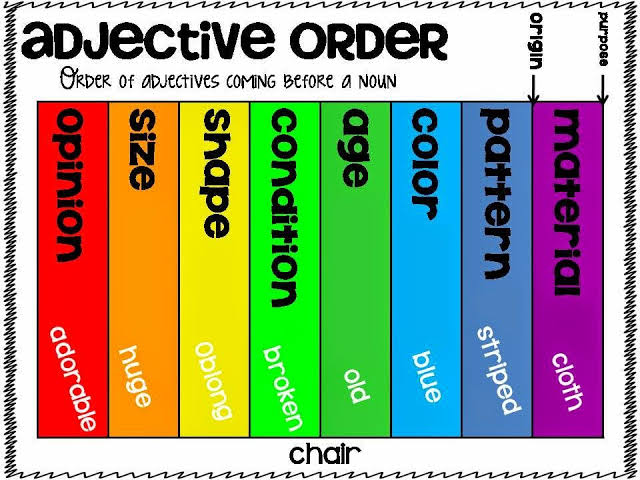
Learn the Order of Adjectives with Ease


The order of adjectives is a topic with diverse applications and usages.

In fact, (about 5) questions are being asked annually on it...in WASSCE, NECO and JAMB examinations.

Let's continue...

Adjectives are words that qualify/modify a noun or a pronoun. In other words, theydescribe a person, place, or thing in a sentence. Adjectives usually come before the noun. For example:

• “The small dog jumped over the white fence.”

Powerful Exercises on the Rules of Concord


R
ubric:  Choose the correct form of the verb that agrees with the subject.

1. Annie and her brothers (is, are) at school.

2. Either my mother or my father (is, are) coming to the meeting.

3. The dog or the cats (is, are) outside.

4. Either my shoes or your coat (is, are) always on the floor.

5. George and Tamara (doesn't, don't) want to see that movie.

6. Benito (doesn't, don't) know the answer.

7. One of my sisters (is, are) going on a trip to France.

8. The man with all the birds (live, lives) on my street.

Lesson Notes on Transitive and Intransitive Verbs


Definition

English verbs are split into two major categories depending on how they function in a sentence: transitive and intransitive. Transitive verbs take one or more objects in a sentence, while intransitive verbs take no objects in a sentence.

Distinguishing between the two Transitive Verbs

Put simply, a transitive verb describes an action that is happening to something or someone, which is known as the verb’s direct object. For instance, in the sentence “I am reading a book,” book is the direct object, which the action reading is happening to.

A Complete Lesson on Diction/Oral English: Vowel and Consonant Sounds


Hello everyone, you're amply welcome to our blog page. Today we shall be examining some momentous lessons under Diction/Speech Work/Oral English.

I'm Mr. Tope.

First and foremost, there is just one alphabet in English Language due to the fact that the term alphabet refers to a collective name given to all 26 letters.

Lessons on Idioms


What is an idiom?

An idiom is an expression where the meaning is different from the meaning of the individual words.

Friday, 11 January 2019

Tambuwal blotted out---This is how I rejected APC bribe not to defect !

     
                              Image result for tambuwal
How I rejected APC bribe not to defect – Tambuwal On January 11, 20199:00 amIn News, Politics178 Comments By Emmanuel Aziken, Political Editor Governor Aminu Tambuwal of Sokoto State has revealed how he spurned the bribe from the Federal Government to construct a road to his village as a way of holding him in the All Progressives Congress, APC. Tambuwal Speaking at a rally in Silame, Sokoto to flag off the PDP campaigns in Sokoto State, Tambuwal fumed at the hunger in the country and what he described as the incompetence of the Muhammadu Buhari led Federal Government in tackling the insecurity problems in the

New: INEC releases 7-step Voting Procedure

                               Image result for 7 step voting by inec     
The Independent National Electoral Commission, INEC, has outlined a seven step voting procedure for next month’s general elections. inec Prof. Mahmood Yakubu, Chairman of the Independent National Electoral Commission (INEC) 2019 poll: 364, 265 PVCs yet to be collected in Ondo The procedure, which was posted on its website, lists the steps as follows and they are not substantially different from those used in recently conducted elections. The steps as stated by INEC are: 
Step 1: Upon arrival at the polling unit, join the queue and present yourself to the INEC official (APO111) at the polling unit who will determine whether you are at the correct polling unit and check if the photograph on the Permanent Voter Card (PVC) matches your face. If satisfied, he/she will direct you to the next INEC official (APO1). 
Step 2: The official (APO1) will request for your PVC to confirm that your card is genuine and your details, using the smart card reader. He/she will ask you to place your finger on the card reader to confirm that the PVC belongs to you by ascertaining, the card reader will contains the name, photograph and finger prints of

Wednesday, 27 July 2016

Dogara gives Abdulmumin Jibrin 7-days to retract libelous allegations or face legal action


 Speaker of the House of Representatives, Yakubu Dogara, has given sacked chairman of the House committee on Appropriation, Abdulmumin Jibrin, a 7-day ultimatum to retract all the allegations of corruption padding he leveled against him since he was sacked form office or face legal action.

Jibrin who was sacked on 20th July, has released several statements accusing Dogara and three other principal of corruption and padding of the 2016 budget. Read Yakubu Dogara's statement below...

The Speaker of the House of Representatives, Rt Hon Yakubu Dogara, has given a seven day ultimatum to Hon Abdulmumin Jibrin to tender an unreserved apology to him and retract all allegations made against him or face legal action. A statement issued by the Special Adviser on Media & Public Affairs to the Speaker, Mr. Turaki Hassan, stated that the demand was contained in a letter written and addressed to Jibrin by counsel to Dogara, Professor Joash Ojo Amupitan (SAN) & Co. It was signed By

Tuesday, 2 February 2016

Corruption: All past leaders are guilty, says Saraki


Senate President, Bukola Saraki
Senate President, Bukola Saraki, said on Tuesday that all public office holders in Nigeria since 1999 were guilty of the mistakes of the past that led the country to its present political and economic mess.
Saraki stated this while responding to a question on the secrecy of the National Assembly budget and corruption allegations leveled against it by former President Olusegun Obasanjo in a recent letter.
The Senate President insisted that it was wrong for anybody to hold an individual or group of people solely responsible for the mess of the past.
He said, “We have all been here since 1999 up to the recent past when things were not done right, we are all part of it. I was there, you were there, every

Monday, 4 January 2016

2016 budget favours youth - APC chieftain

Saturday, 5 December 2015

After HID Awolowo’s burial, Ikenne turns deserted


Sun up on Thursday, November 26, 2015: Ikenne, provincial homestead of one of Africa’s foremost political thinkers, statesmen, nationalists and former Premier of the defunct Western Region of Nigeria, the late Chief Obafemi Awolowo, gradually rouses from the fatigue and hangover of the orgy of celebration of the funeral of the widow of the late sage, Chief (Mrs.) Hannah Idowu Dideolu Awolowo, buried the previous day.
The streets, the markets and the motor parks still bear vestiges of the revelry of the night before as they were littered with dis­carded plastic food packs, disused water bot­tles and sachets, yoghurt and chocolate packs and cellophane bags. This is in spite of huge piles of the stuffs already gathered and ar­ranged by the roadside for sale by enterprising scavengers, mostly women.
At the Obafemi Awolowo Square, Dideo­lu Stores along Tai Solarin Way, the town’s major road, Our Saviour’s Anglican Church along Kehinde Sofola Street (where the fu­neral service was held), Yeye Odua (former Ajina) Street and several other reception ven­ues used by the government of Ogun State, Awolowo’s kinsmen, the towns folk and vari­ous groups in hosting guests; workmen and officials of the state’s Traffic Compliance and Enforcement (TRACE) agency are seen busy dismantling canopies and security barricades.
Although offices and schools have re­sumed after the one-day unofficial holiday declared in honour of the Awolowo matriarch, only few shops are opened for business even as at 9:00am. Traffic was light. Save for some commercial bike operators on the prowl for passengers, only few cars and township taxi cabs ply the roads. Indeed as the day wears on, the major motor park in the heart of the town has become virtually deserted. Only a handful of officials of the National Union of Road Transport Workers (NURTW) and touts are seen either seated on benches or play­ing with young female hawkers. There is no vehicle on turn. A few only drives in and out of the park without stopping, after finding no passengers to pick.
Ironically, the light human activity sharply contrasts with the profuse presence of roam­ing pets and other domestic animals- dogs, goats, hens, which, as if with an understand­ing with their owners, came out of a two-month forced hibernation with their brood to sun their furs and feathers. Saturday Sun al­most twice ran over two flocks of hens and their chicks on different lanes and saw local dogs stray across the roads at will, while rid­ing round the town.
At last, the “townlet’, (as that is what it can be called with its

Featured post

Go and take your Weekly Assessment Test now !

    You're welcome. Your weekly assessment online test is now available ! You can take the test from now till 11.59pm tonight, Saturday,...

Popular Posts